History
Free-nets: the accounts volunteers kept alive
How free-nets ran on volunteer labour, dial up lines and library terminals, and why a federated address still works the same way.
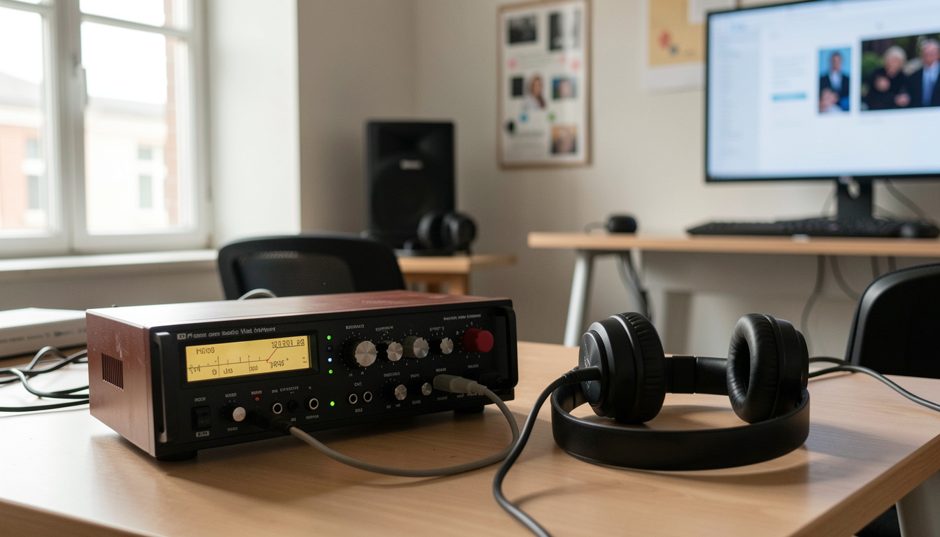
A free-net was a community computer system that anyone in a city could dial into, usually for the price of a local call, and use for mail, forums, chat and public information. The first one open to the general public was the Cleveland Free-Net, launched in 1986 by Case Western Reserve University. Houston followed in 1993 with the Greater Houston Free-Net. To understand what was a free-net, start with the arrangement rather than the software: a host somebody else owned, a bank of modems, terminals placed where people already went, and a volunteer who kept the account alive.
A host, a rack of modems and a phone bill
The hardware was ordinary for its decade. A minicomputer or a Unix workstation sat in a university machine room or a hospital basement, connected to a hunt group of dial up lines. Eight, sixteen, thirty two modems in a shelf, each one a call waiting to be answered. The cost was not the machine, which was often donated or surplus, but the lines, the staff time and the electricity. A free-net with thirty lines could burn several thousand dollars a month in telephone charges alone, which is why so few of them were ever fully independent of an institution.
Membership was the other half of the ledger. Some systems charged nothing and asked for a donation; others charged ten or twenty dollars a year, which bought an account and a vote. Almost all of them had a rule about who could hold an account: residents of the service area, sometimes students, sometimes anyone who could reach the modem pool. The account was the unit of belonging. It carried a name, a mailbox, a quota and a set of permissions, and it was issued by a person rather than generated by a signup form.
Which was the first community computer network open to the public?
The Cleveland Free-Net is the usual answer, and the record supports it. It opened in 1986, grew out of an earlier experiment at Case Western Reserve University, and was free to anyone who could dial in. Its model spread quickly. The National Public Telecomputing Network, founded in 1989, acted as a clearing house for cities that wanted to start their own, and by the mid 1990s there were free-nets in dozens of American cities and a few outside the country.
The software mattered as much as the idea. FreePort, written for the Cleveland system, was shared between sites, adapted, patched and passed on. A city that wanted a free-net did not write a platform from scratch; it took the same code, changed the menus, found a host and recruited volunteers. That habit of reuse is worth noting, because it is the same habit that later shaped the federated protocols.
Did Houston have a free community network in the 1990s?
Yes. The Greater Houston Free-Net opened in 1993, run by a nonprofit and hosted with institutional support, and it offered the familiar menu of mail, conferences, local information and dial up access. It was one of several Texas systems of the period, and like most of them it depended on a small paid staff and a larger body of volunteers who answered questions, moderated forums and kept the hardware running.
Houston also shows how fragile the model was. When the sponsoring institution changed priorities or the phone bill outgrew the donations, the system had to find a new host, a new fiscal agent or a new set of volunteers. Some free-nets migrated to the web and became community portals; others closed their modem pools and let the domain lapse. The account, which had been the point of the whole thing, disappeared with the host.
Libraries and associations as the access point
The people who used free-nets were not always the people who owned computers. In 1990 a home machine with a modem was a real expense, and a household without one still needed a way in. Public libraries, community centres, senior centres and university labs filled that gap. A terminal in a library reference room, a few chairs, a printed card with the dial up number: that was the access point for anyone who could not afford the hardware.
Staff at those sites did more than unlock a door. They taught the first session, reset forgotten passwords, explained why the line was busy at seven in the evening. Library systems in Cleveland, Houston and elsewhere treated the free-net as a service to be explained rather than a machine to be pointed at. That is the same role a library plays today when it lends a hotspot or keeps a public terminal open, and the same role a community network plays when it puts an access point on a housing estate.
The account somebody else issues
The continuity is easy to miss because the transport changed. A federated address is still a name issued by an administrator on a machine that administrator controls, and the local part of that address is still the part that belongs to the community. The domain may be a city, a cooperative, a club or a library; the server may be a rack in a basement or a virtual machine rented by the month. What has not changed is the split between the platform and the account.
That split is the reason the local part is worth keeping separate. When a free-net closed, its members lost their names because the name lived on the host and the host went away. A federated system that lets a community run its own server, and point its own domain at it, keeps that failure mode smaller. The account can move; the identity can survive the machine.
What the volunteers were actually doing
Running one of these systems was less like administering a service and more like keeping a small institution alive. Somebody had to watch the modem pool, replace a failed drive, answer the mail from people who could not log in, and argue with the phone company about a bill. That work was rarely paid and rarely visible, and it is the reason the systems existed at all.
The same is true of the community networks that came after them, whether they run fibre in a municipality, a mesh in a neighbourhood or a mail server for a few hundred people. The technology is documented, the protocols are public, and the hard part remains the same: a host, a connection, a name, and a person willing to keep the account alive.